

Shifting Light, Unchanging Haystacks
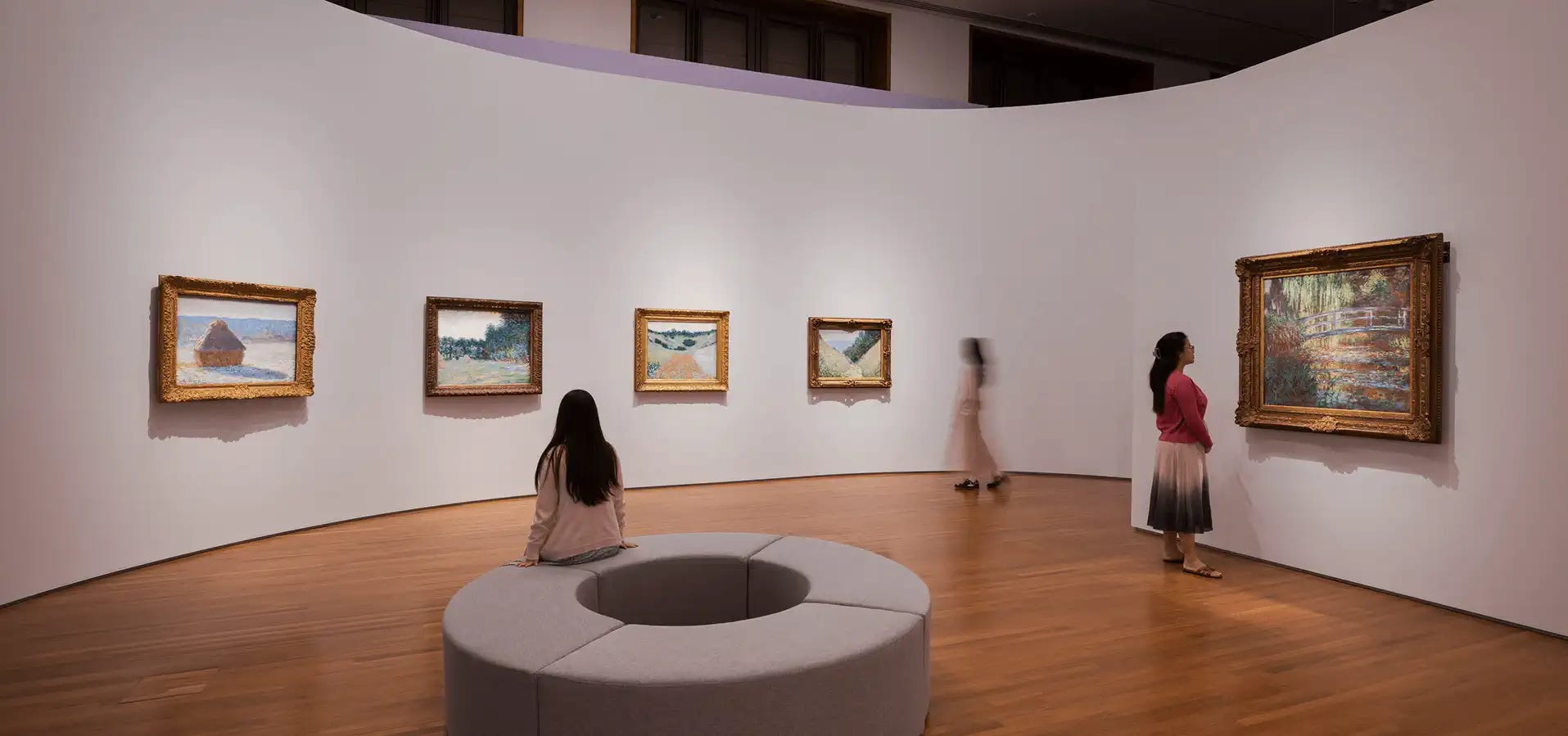
Two weeks ago, taking the opportunity of attending iOS Conf SG 2026, I visited the National Gallery Singapore and had the pleasure of viewing the special exhibition “Into the Modern: Impressionism from the Museum of Fine Arts, Boston”. Although I have seen many excellent exhibitions in the past, this experience resonated with me in a distinct and unexpected way.
The National Gallery Singapore is formed by merging two historically significant national monuments—the former Supreme Court and the City Hall. Architects connected these two classical structures with a minimalist metal and glass roof, creating a striking sense of place architecturally: history and modernity intertwined within the same physical space. The ongoing exhibition “Into the Modern”, which features over one hundred original works by masters such as Monet, Renoir, Manet, Cézanne, and Degas, elevates this cross-temporal dialogue to the realm of art.
The exhibition does not simply follow a chronological timeline; instead, it uses “modernity” as its core narrative thread, unfolding layer by layer through themes like “Cities and Change”, “Light and Moments,” and “Class and Leisure”. Although the “modern” here refers to the late 19th century, the urban renewal of Paris, the evolution of lighting techniques, and the rise of new forms of leisure depicted in the paintings all demonstrate, from multiple dimensions, the rhythm of social progress in that era. In this space where time and geography cross, the exhibition goes far beyond the mere level of “viewing art.” For someone like me, who is swept along daily by the torrent of “new tech” information on social media, this was a rare moment of tranquility and introspection.
Returning to reality, in just the past few days, the names of the hottest AI projects have shifted from Clawdbot to Moltbot, and then rapidly evolved into OpenClaw. From a microscopic perspective, we seem to be living in an era of change measured in minutes and seconds. However, if we were to look back at the current AI fever from a longer time scale years from now, we might discover that the world did not undergo the radical, fundamental mutations that we perceive while caught in the current.
Immersed in this environment, it is inevitable that we feel excitement—or even anxiety—over the endless stream of new technologies and tools. Perhaps, beyond these emotions, what we need is a deeper sense of grounding. History repeatedly reminds us that any “high tech” has its temporal limitations. Just as Monet repeatedly depicted the same haystack under different times and lighting conditions: the painting techniques may evolve, but the core object remains unchanged. What truly changes is often the way of seeing, the depth of understanding, and the creator’s own state of mind.
When facing the “present and future”, perhaps we can afford to be less frantic in our pursuit of change, and more composed in our contemplation of the moment.
Previous Issue|Newsletter Archive
This Week’s Sponsor
Need to debug HTTPS on your iPhone?
Try Proxyman! The best-in-class macOS that helps you capture/debug HTTP(s) with a few clicks. Support iOS devices and Simulator.
Recent Recommendations
DebugReplaceableView and Swift 6.2’s Multiple Type Erasers
You may still find Xcode Previews less than ideal, but Apple has been actively optimizing this experience over the past few years with notable progress. Starting with Xcode 16, views are automatically converted to AnyView via @_typeEraser in preview and debug modes to provide richer debugging information. From Xcode 26 onwards, the enhanced @_typeErasernow supports multiple type erasers, converting views to DebugReplaceableView on macOS/iOS 26+ platforms. This enables hot-swapping of views without rebuilding the entire view hierarchy, further improving preview performance. In this article, Kyle Ye dives deep into the compiler source code to analyze the implementation, explaining how the compiler automatically selects the appropriate type eraser based on platform availability.
Tiered Caching in Swift
When you need to balance performance, memory footprint, and data consistency simultaneously, a single caching strategy often falls short. In this article, Kyle Browning provides a practical guide to implementing tiered caching in Swift: organizing memory and disk caches into a clear hierarchical structure, combined with flexible cache policies (such as cacheThenFetch, cacheElseFetch, etc.) to enable data to flow smoothly between different access cost tiers.
SwiftUI: Realtime, Multi-User Content Collaboration With CloudFlare +YJS-Swift
Despite the availability of numerous services and frameworks, implementing real-time collaborative editing remains a significant engineering challenge. In this article, Itsuki demonstrates how to build a low-cost, scalable, multi-user real-time collaborative content editing system in SwiftUI using Cloudflare Durable Objects + WebSocket Hibernation API + YJS-Swift.
Particularly noteworthy is the author’s detailed explanation of how to properly maintain text cursor and selection positions when receiving remote content updates in SwiftUI—this is closely aligned with real-world product development and clearly represents hard-won experience from actual implementation.
Swift Actors: 6 pitfalls that will catch even experienced developers
Actors are one of the most important—and most easily misunderstood—features in Swift’s concurrency model. Reality, however, is far more complex than it appears. In this article, Rafał Dubiel summarizes 6 Actor pitfalls that even experienced developers commonly encounter: state inconsistency caused by reentrancy, the performance cost of Actor hopping, thread-safety vulnerabilities when @MainActor interacts with Objective-C callbacks, the risks of misusing @unchecked Sendable, misconceptions about nonisolated, and the counterintuitive fact that Actors don’t guarantee execution order.
Rafał doesn’t stop at conceptual warnings—he explains through concrete scenarios why these issues genuinely exist and why they’re so easy to overlook.
Designing a Scalable App-Wide Theming System in SwiftUI
Implementing app-wide theming in SwiftUI may seem like a simple “style management” problem, but it easily touches on deeper design decisions involving state propagation, dependency injection, and view refresh boundaries. Sagar Unagarapproaches this from a real-world requirement, demonstrating a comprehensive theming system design based on SwiftUI’s Environment: using EnvironmentKey to make themes accessible like built-in environment values, and replacing scattered hardcoded values with semantic Design Tokens.
Sagar’s focus isn’t just on “how to do it,” but on “which approach is more maintainable in the long run”—this solution doesn’t depend on any specific library, with its core philosophy being “semantic + reactive,” easily extensible to fonts, spacing, corner radius, and other design elements.
Call Once
“Ensuring a closure executes only once” sounds like a basic requirement, but in real systems, it’s often not as simple as adding a boolean flag. In this article, Paul Samuels demonstrates how to encapsulate this behavior using @propertyWrapper, progressively evolving the solution: from a basic version supporting only () -> Void, to introducing generics for return values, and finally leveraging Swift’s Parameter Packs (each Argument) to support arbitrary function signatures.
This is a thought-provoking article whose value lies not only in the final CallOnce implementation, but in demonstrating how to progressively combine multiple Swift language features to solve a seemingly simple yet representative engineering problem.
Tools
SwiftUI-Agent-Skill: Making AI Write More Reliable SwiftUI Code
If you’re using AI coding assistants (like Claude Code, Cursor, or Codex), you’ve likely encountered this problem: AI-generated SwiftUI code uses deprecated APIs, or deviates from best practices in state management and view organization—even when you’ve repeatedly emphasized these requirements in your base rules.
SwiftUI-Agent-Skill, released by Antoine van der Lee, is designed to bridge this “last mile” gap. It provides AI tools with expert-level SwiftUI guidance covering state management trade-offs, modern API replacements, performance and maintainability checks, and iOS 26+ Liquid Glass usage boundaries—turning “the places where SwiftUI code most commonly goes wrong” into a reusable, executable review workflow.
In addition to this skill, Antoine also provides skills for Swift Concurrency and Core Data.
I recommend that developers don’t just configure these into their AI environment and call it done—these skill documents themselves are structured summaries of practical experience in specific domains. Reading through them carefully benefits not just your AI, but elevates your own understanding as well.
PierreDiffsSwift: Render Beautiful Code Diff Views in macOS Apps
PierreDiffsSwift, developed by James Rochabrun, helps developers render beautiful, syntax-highlighted code diff views in macOS applications.
The library provides an out-of-the-box solution: built on the @pierre/diffs JavaScript library, wrapped into SwiftUI-native views via WKWebView, supporting syntax highlighting for 40+ languages, Split/Unified view modes, inline word-level change highlighting, and automatic dark/light theme switching.
Thanks for reading Fatbobman’s Swift Weekly! This post is public so feel free to share it.
变幻的光影,不变的干草堆
两周前,借着参加 iOS Conf SG 2026 的契机,我造访了新加坡国立美术馆,并有幸参观了《走进现代:波士顿美术博物馆印象派大师展》。尽管此前也看过不少优秀的展览,但这次经历仍带来了某种不同寻常的触动。
新加坡国立美术馆由两座极具历史分量的国家古迹——前最高法院与前市政厅——合并而成。设计师以极简的金属与玻璃屋顶将两座古典建筑连接在一起,在建筑层面便营造出一种强烈的临场感:历史与现代在同一物理空间中彼此交织。而正在展出的特展《Into the Modern》,汇集了莫奈、雷诺阿、马奈、塞尚、德加等 25 位大师的一百余幅原作,则将这种跨越时间的对话进一步推向了艺术层面。
展览并未简单依循时间线展开,而是以“现代性”为核心叙事线索,通过“城市与变革”“光影与瞬间”“阶级与休闲”等主题层层铺陈。尽管这里的“现代”指向的是 19 世纪末,但画作中所呈现的巴黎城市改造、光影技法的演变,以及新兴休闲与娱乐方式的兴起,无不从多个维度展现了那个时代社会前行的节奏。在这样一个时空交错的场域中,展览早已超越了单纯“观看艺术品”的层次。对于每天都被社交媒体时间线中海量“新技术”信息裹挟的我而言,这无疑是一段难得的平静与反思时刻。
回到现实,仅仅在过去的几天里,大热 AI 项目的名字就从 Clawdbot 变成 Moltbot,又迅速演化为 OpenClaw。从微观视角看,我们仿佛正身处一个以分秒计量的变革时代;但若在若干年后,从更长的时间尺度重新审视当下的 AI 热潮,或许会发现,世界并未如洪流之中的我们所感知的那样,发生着本质上的突变。
身处其中,我们难免会因层出不穷的新技术、新工具而兴奋,甚至焦虑。或许,在这种情绪之外,更需要一种更深层的定力。历史反复提醒我们,任何“高技术”都具有其时间局限性。正如莫奈在不同时间、不同光线下反复描绘同一座干草堆:绘画技法在变化,但核心对象始终未变;真正发生变化的,往往是观看方式、理解层次与创作者自身的心境。
在面对“现在与未来”时,也许我们可以少一些追逐变革的慌张,多一些凝视瞬间的从容。
本期赞助
调试 iOS 网络请求总是被证书配置难住?
Proxyman 是一款为 iOS 开发者打造的现代 HTTP 抓包工具。支持 SSL 代理、GraphQL、WebSocket 及强大的脚本注入功能。告别笨重的传统工具,体验专为 macOS 优化的极致调试效率。
近期推荐
SwiftUI 调试背后的多重类型擦除机制 (DebugReplaceableView and Swift 6.2’s Multiple Type Erasers)
或许你可能对 Xcode 的 Preview 仍不甚满意,但其实在过去几年间,苹果一直在这方面积极地进行着优化工作,并且取得了不少的进展。比如,从 Xcode 16 开始,便在预览和调试模式下,通过 @_typeEraser 自动将视图转换为 AnyView 以增加更多的调试信息。而从 Xcode 26 开始,通过增强 @_typeEraser 使其支持多重类型擦除器,在 macOS/iOS 26+ 平台上将视图转换成 DebugReplaceableView,实现视图的热替换而无需重建整个视图层级,进一步改善预览性能。在本文中,Kyle Ye 从编译器源码层面深入剖析了这一机制的实现原理,解释了编译器如何根据平台可用性自动选择合适的类型擦除器。
Swift 中的分层缓存设计 (Tiered Caching in Swift)
在需要同时兼顾性能、内存占用与数据一致性的场景中,单一缓存策略往往很快就会捉襟见肘。这篇文章中,Kyle Browning 以实践视角系统介绍了分层缓存(Tiered Caching)在 Swift 中的实现思路:通过将内存缓存与磁盘缓存组织成清晰的层级结构,配合灵活的缓存策略(如 cacheThenFetch、cacheElseFetch 等),让数据在不同访问成本之间有序流动。
基于 Cloudflare 的 SwiftUI 实时协作编辑实践 (SwiftUI: Realtime, Multi-User Content Collaboration With CloudFlare +YJS-Swift)
尽管市面上已经存在不少现成的服务与框架,实时协作编辑在工程层面依然是一道不低的门槛。本文中,Itsuki 系统性地展示了如何在 SwiftUI 中,借助 Cloudflare Durable Objects + WebSocket Hibernation API + YJS-Swift,构建一个低成本、可扩展、支持多用户实时协作的内容编辑系统。
尤其值得一提的是,作者详细分享了在 SwiftUI 接收远程内容更新时,如何正确维护文本光标与选区位置的处理技巧——这一部分非常贴近真实产品开发,明显属于“踩过坑之后才会写出来”的经验。
Swift Actor 的 6 个常见陷阱 (Swift Actors: 6 pitfalls that will catch even experienced developers)
Actor 是 Swift 并发模型中最重要、也最容易被“想当然”使用的语言特性之一,然而现实远比这复杂。Rafał Dubiel 在本文中总结了 6 个即使是资深开发者也常踩的 Actor 陷阱:可重入性导致的状态不一致、Actor Hopping 的性能代价、@MainActor 与 Objective-C 回调交互时的线程安全漏洞、@unchecked Sendable 的滥用风险、nonisolated 的误解,以及 Actor 并不保证执行顺序这一反直觉的事实。
Rafał 并未停留在概念层面的提醒,而是结合具体场景解释这些问题为何真实存在、又为何容易被忽视。
SwiftUI 全局主题系统的可扩展设计 (Designing a Scalable App-Wide Theming System in SwiftUI)
在 SwiftUI 中实现全局主题(Theming),看似是个“样式管理”问题,实则很容易牵扯到状态传播、依赖注入以及视图刷新边界等更深层的设计选择。Sagar Unagar 从一个现实需求出发,系统展示了一套基于 SwiftUI Environment 的全局主题系统设计:通过 EnvironmentKey 让主题像内置环境值一样访问,以语义化的 Design Tokens 取代散落各处的硬编码值。
Sagar 关注的并不仅是“如何做”,而是“哪种方式在长期更可控”——这套方案不依赖特定库,核心思想是“语义化 + 响应式”,可以轻松扩展到字体、间距、圆角等设计要素。
在 Swift 中实现“只执行一次”的优雅方式 (Call Once)
“确保闭包只执行一次”听起来像是一个再基础不过的需求,但在真实系统里,这往往并不只是加一个布尔值那么简单。Paul Samuels 在本文中展示了如何用 @propertyWrapper 封装这一行为,并逐步演进:从只支持 () -> Void 的基础版本,到引入泛型支持返回值,最终借助 Swift 的 Parameter Packs(each Argument)实现对任意函数签名的支持。
这是一篇偏思考型的文章,其价值不仅在于最终的 CallOnce 实现,更在于展示了如何将多个 Swift 语言特性逐步组合起来,解决一个看似简单却颇具代表性的工程问题。
工具
SwiftUI-Agent-Skill:让 AI 写出更“靠谱”的 SwiftUI 代码
如果你正在使用 AI 编程助手(如 Claude Code、Cursor、Codex),很可能遇到过类似的问题:AI 生成的 SwiftUI 代码使用了过时的 API,或在状态管理、视图组织上偏离最佳实践——即便你已经在基础规则中反复强调过这些要求。
Antoine van der Lee 发布的 SwiftUI-Agent-Skill,正是为了解决这一“最后一公里”的落差。它为 AI 工具提供了一套专家级的 SwiftUI 指导规范,涵盖状态管理取舍、现代 API 替换、性能与可维护性检查,以及 iOS 26+ 的 Liquid Glass 使用边界等内容,把“SwiftUI 最容易写歪的地方”整理成可复用、可执行的审查流程。
除了这套 skill 外,Antoine 还提供了面向 Swift Concurrency 和 Core Data 的 skill。
我建议开发者不要只是把它们简单配置进 AI 环境中就结束了——这些 skill 文档本身就是对某一领域实践经验的结构化总结。认真读一遍,受益的不只是 AI,你自己也会随之进阶。
PierreDiffsSwift:在 macOS 应用中渲染精美的代码 Diff 视图
James Rochabrun 开发的 PierreDiffsSwift,帮助开发者在 macOS 应用中渲染漂亮的、带语法高亮的代码 Diff 视图。
该库提供了一个开箱即用的解决方案:基于 @pierre/diffs JavaScript 库,通过 WKWebView 封装成 SwiftUI 原生视图,支持 40+ 种语言的语法高亮、Split/Unified 两种视图模式、行内单词级变更高亮,以及深色/浅色主题自动切换。